After we traced the grandparents in Ostrów in the first part of the history of the Ledermann family from the Lützow Quarter—who later died in Breslau, today we follow the parents of Franz Ledermann: the jurist Benno Benjamin Ledermann and his wife Lucie, née Schachtel.
The father: Benno Benjamin Ledermann.
The father, Benno Benjamin Ledermann, born on 4 March 1847 in Ostrowo, had already moved from Ostrowo to Breslau during his school years, probably around 1860. He attended the Catholic Royal St. Matthias Gymnasium there , where he completed his Abitur at Michaelmas (autumn) 1868 together with 17 others, before going on to study law. Three of the graduates were of Jewish faith; only Benjamin came from Ostrowo. We can assume with some confidence that he also studied in Breslau, but (digitized) university matriculation records are not available for verification.
The first report of his legal career is his appointment as Referendar (legal trainee) in 1872 (Amtsblatt der Regierung in Breslau, 1872). The next notice we found appeared on the front page of the Jüdische Presse in 1874—by this time he had passed his legal examinations, was 27 years old, and was serving as a legal trainee. At a political meeting of the Jewish community in Breslau on Sunday, 22 February 1874, he argued in a “lengthy speech … that the proceedings had no right whatsoever, without the knowledge of the other members and in a meeting not convened for this purpose, to pass a resolution binding on all members or to make an amendment to the statutes”.
Only three years later, the Referendar Benjamin Ledermann was appointed Assessor and transferred as district judge to the district court of Beuthen in Upper Silesia (Amtsblatt der Regierung in Breslau, 1877). This apparently provided sufficient social security for him to marry; his eldest son Curt was then born in Beuthen.
According to later statements by his son Franz, a position as district judge in Königshütte followed (his daughter Käthe was born there in 1881), and finally, in the same year, he established himself as an attorney in Hirschberg in the Giant Mountains, where Franz was born in 1889. He received his license to practice law at the Hirschberg regional court in 1881 (Juristische Wochenschrift 1881), became a notary there in 1895 with the “designation of his residence in Hirschberg” (Deutsche Justiz 1895), and achieved appointment as Justizrat in 1897 (Der Gemeindebote, March 1897). A few weeks before his death in 1911, he was awarded the Prussian Order of the Red Eagle. All of this suggests a slow but steady rise in social status: from the West Prussian province (Ostrowo) through the Upper Silesian mining region (Beuthen, Königshütte) to the Hirschberg Valley in Lower Silesia at the foot of the Giant Mountains (Hirschberg), a traditional holiday destination for Berliners in the 19th and 20th centuries.
And Benjamin—by then usually called Benno Ledermann—was active: in the Association of Synagogue Communities of the administrative districts of Breslau and Liegnitz at its founding in 1897 and in the following years; in the German National Association of Jewish Religious Teachers; in the founding of a Jewish teachers’ home; in the “Association for Jewish History and Literature”; in the Israelite Women’s Aid Association of Hirschberg; on the board of the Jewish spa hospital in Warmbrunn. And when the village of Stonsdorf, near Hirschberg, celebrated the 100th anniversary of “Echt Stonsdorfer Kräuterschnaps” in 1910, the Justizrat delivered there as well a “retrospective on the development of the company” (3). Even everyday matters such as the search for a substitute for the cantor and ritual slaughterer of his community apparently did not proceed without his involvement.
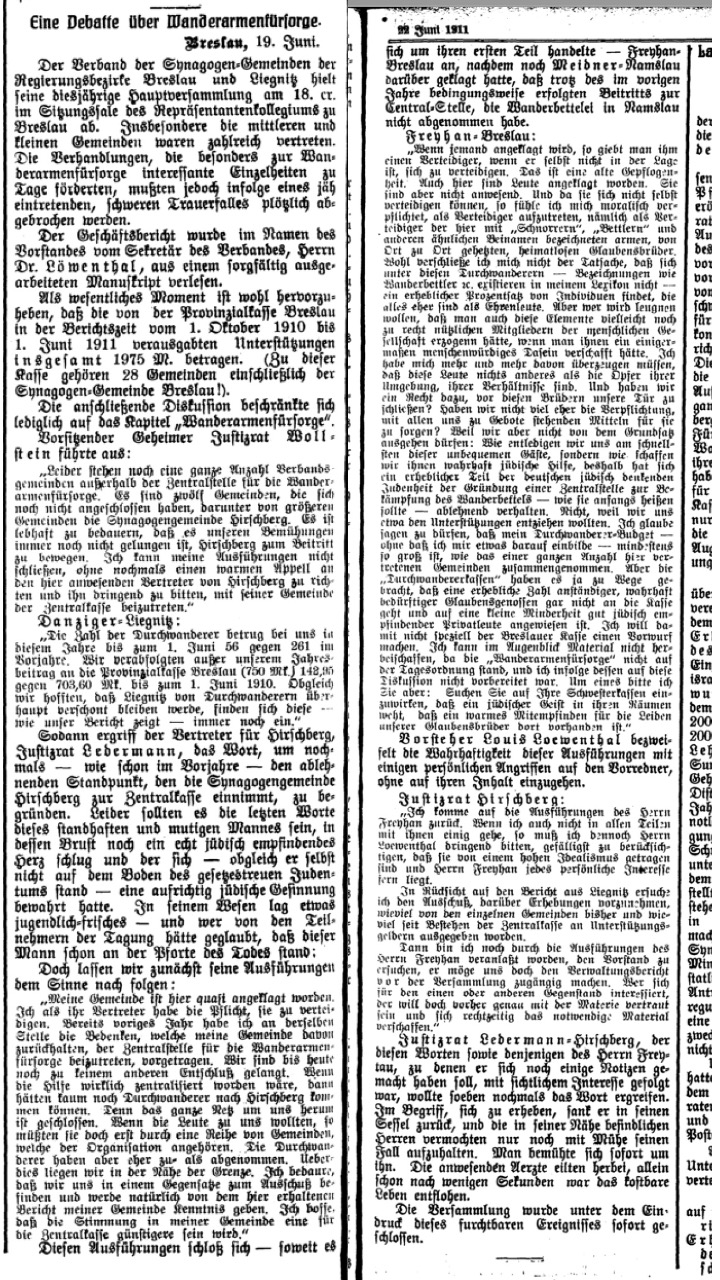
Tragically, it was likely this very commitment that became his undoing: Benno Ledermann died on 18 June 1911 at the age of only 65 from a heart attack during a meeting of the synagogue association, at which he had given a passionate speech. The details were later reported in several daily and weekly newspapers, together with an appreciation of his work: At the annual meeting of the association, “the representative for Hirschberg, Justizrat Ledermann, took the floor once again—as he had the previous year—to justify the opposing position taken by the Hirschberg synagogue community … Unfortunately, these were to be the last words of this steadfast and courageous man, in whose breast beat a truly Jewish-feeling heart and who—although he himself did not stand on the ground of
law-abiding Judaism—had preserved a genuinely Jewish attitude … [this is followed by an excerpt from his speech, as well as those of other speakers] … Justizrath Ledermann of Hirschberg, who had followed these words with visible interest, was just about to take the floor once more. As he was about to rise, he sank back into his chair, and the gentlemen near him were only barely able to break his fall … The physicians present hurried over, but after only a few seconds the precious life had already fled”. The meeting was not resumed until November 1911.
The mother: Lucie Ledermann, née Schachtel.
District judge Benno Ledermann in Beuthen (Upper Silesia) became engaged in June 1878 to Lucie Schachtel, as reported by the Berliner Tagblatt (28 June 1878), and he married her on 10 November 1878 in Breslau. She was born on 26 June 1860, the daughter of the local furrier master Markus Schachtel and his wife Rosalie, née Eisenstädt. In the Breslau address book of 1874, the family appears at Goldene Radegasse 13 (also Antonienstr. 3), a house in the city center, though not one owned by the furrier. They were the only family with that surname in Breslau.
The couple had three children: Curt Otto, born in 1879 in Beuthen; Hedwig Käthe, born in 1881 in Königshütte; and the youngest son, Franz Anton, born in 1889 in Hirschberg. The next three chapters of the family history will be devoted to them.
Typically, in this period, wives “disappear” in official documents behind their husbands and are neither listed in address books nor otherwise publicly visible. Only after her husband’s death did “Frau Justizrat Ledermann” appear occasionally, for example in the Israelite Women’s Association of Hirschberg and in the donation lists of Jewish welfare organizations. After her husband’s death, the widow deregistered from Hirschberg on 6 May 1915 and moved to Posen, where she lived at Wittingstrasse 12, the address of her son-in-law Felix Kämpfer and her daughter. After they moved to Berlin in 1920, she returned to Hirschberg (in the 1935 address book her address is given as Stonsdorfer Str. 2), where she died on 12 September 1936 at the age of 76. She may have died in the assumed security that her two children, Franz and Käthe, were safe from the Nazis after their emigration to Holland—although in the “Gau Silesia” as well the terrorization of the Jewish population by the National Socialists, called the “new era,” had long since begun.
The father: Benno Benjamin Ledermann.
The father, Benno Benjamin Ledermann, born on 4 March 1847 in Ostrowo, had already moved from Ostrowo to Breslau during his school years, probably around 1860. He attended the Catholic Royal St. Matthias Gymnasium there , where he completed his Abitur at Michaelmas (autumn) 1868 together with 17 others, before going on to study law. Three of the graduates were of Jewish faith; only Benjamin came from Ostrowo. We can assume with some confidence that he also studied in Breslau, but (digitized) university matriculation records are not available for verification.
The first report of his legal career is his appointment as Referendar (legal trainee) in 1872 (Amtsblatt der Regierung in Breslau, 1872). The next notice we found appeared on the front page of the Jüdische Presse in 1874—by this time he had passed his legal examinations, was 27 years old, and was serving as a legal trainee. At a political meeting of the Jewish community in Breslau on Sunday, 22 February 1874, he argued in a “lengthy speech … that the proceedings had no right whatsoever, without the knowledge of the other members and in a meeting not convened for this purpose, to pass a resolution binding on all members or to make an amendment to the statutes”.
Only three years later, the Referendar Benjamin Ledermann was appointed Assessor and transferred as district judge to the district court of Beuthen in Upper Silesia (Amtsblatt der Regierung in Breslau, 1877). This apparently provided sufficient social security for him to marry; his eldest son Curt was then born in Beuthen.
According to later statements by his son Franz, a position as district judge in Königshütte followed (his daughter Käthe was born there in 1881), and finally, in the same year, he established himself as an attorney in Hirschberg in the Giant Mountains, where Franz was born in 1889. He received his license to practice law at the Hirschberg regional court in 1881 (Juristische Wochenschrift 1881), became a notary there in 1895 with the “designation of his residence in Hirschberg” (Deutsche Justiz 1895), and achieved appointment as Justizrat in 1897 (Der Gemeindebote, March 1897). A few weeks before his death in 1911, he was awarded the Prussian Order of the Red Eagle. All of this suggests a slow but steady rise in social status: from the West Prussian province (Ostrowo) through the Upper Silesian mining region (Beuthen, Königshütte) to the Hirschberg Valley in Lower Silesia at the foot of the Giant Mountains (Hirschberg), a traditional holiday destination for Berliners in the 19th and 20th centuries.
And Benjamin—by then usually called Benno Ledermann—was active: in the Association of Synagogue Communities of the administrative districts of Breslau and Liegnitz at its founding in 1897 and in the following years; in the German National Association of Jewish Religious Teachers; in the founding of a Jewish teachers’ home; in the “Association for Jewish History and Literature”; in the Israelite Women’s Aid Association of Hirschberg; on the board of the Jewish spa hospital in Warmbrunn. And when the village of Stonsdorf, near Hirschberg, celebrated the 100th anniversary of “Echt Stonsdorfer Kräuterschnaps” in 1910, the Justizrat delivered there as well a “retrospective on the development of the company” (3). Even everyday matters such as the search for a substitute for the cantor and ritual slaughterer of his community apparently did not proceed without his involvement.
Tragically, it was likely this very commitment that became his undoing: Benno Ledermann died on 18 June 1911 at the age of only 65 from a heart attack during a meeting of the synagogue association, at which he had given a passionate speech. The details were later reported in several daily and weekly newspapers, together with an appreciation of his work: At the annual meeting of the association, “the representative for Hirschberg, Justizrat Ledermann, took the floor once again—as he had the previous year—to justify the opposing position taken by the Hirschberg synagogue community … Unfortunately, these were to be the last words of this steadfast and courageous man, in whose breast beat a truly Jewish-feeling heart and who—although he himself did not stand on the ground of
law-abiding Judaism—had preserved a genuinely Jewish attitude … [this is followed by an excerpt from his speech, as well as those of other speakers] … Justizrath Ledermann of Hirschberg, who had followed these words with visible interest, was just about to take the floor once more. As he was about to rise, he sank back into his chair, and the gentlemen near him were only barely able to break his fall … The physicians present hurried over, but after only a few seconds the precious life had already fled”. The meeting was not resumed until November 1911.
The mother: Lucie Ledermann, née Schachtel.
District judge Benno Ledermann in Beuthen (Upper Silesia) became engaged in June 1878 to Lucie Schachtel, as reported by the Berliner Tagblatt (28 June 1878), and he married her on 10 November 1878 in Breslau. She was born on 26 June 1860, the daughter of the local furrier master Markus Schachtel and his wife Rosalie, née Eisenstädt. In the Breslau address book of 1874, the family appears at Goldene Radegasse 13 (also Antonienstr. 3), a house in the city center, though not one owned by the furrier. They were the only family with that surname in Breslau.
The couple had three children: Curt Otto, born in 1879 in Beuthen; Hedwig Käthe, born in 1881 in Königshütte; and the youngest son, Franz Anton, born in 1889 in Hirschberg. The next three chapters of the family history will be devoted to them.
Typically, in this period, wives “disappear” in official documents behind their husbands and are neither listed in address books nor otherwise publicly visible. Only after her husband’s death did “Frau Justizrat Ledermann” appear occasionally, for example in the Israelite Women’s Association of Hirschberg and in the donation lists of Jewish welfare organizations. After her husband’s death, the widow deregistered from Hirschberg on 6 May 1915 and moved to Posen, where she lived at Wittingstrasse 12, the address of her son-in-law Felix Kämpfer and her daughter. After they moved to Berlin in 1920, she returned to Hirschberg (in the 1935 address book her address is given as Stonsdorfer Str. 2), where she died on 12 September 1936 at the age of 76. She may have died in the assumed security that her two children, Franz and Käthe, were safe from the Nazis after their emigration to Holland—although in the “Gau Silesia” as well the terrorization of the Jewish population by the National Socialists, called the “new era,” had long since begun.
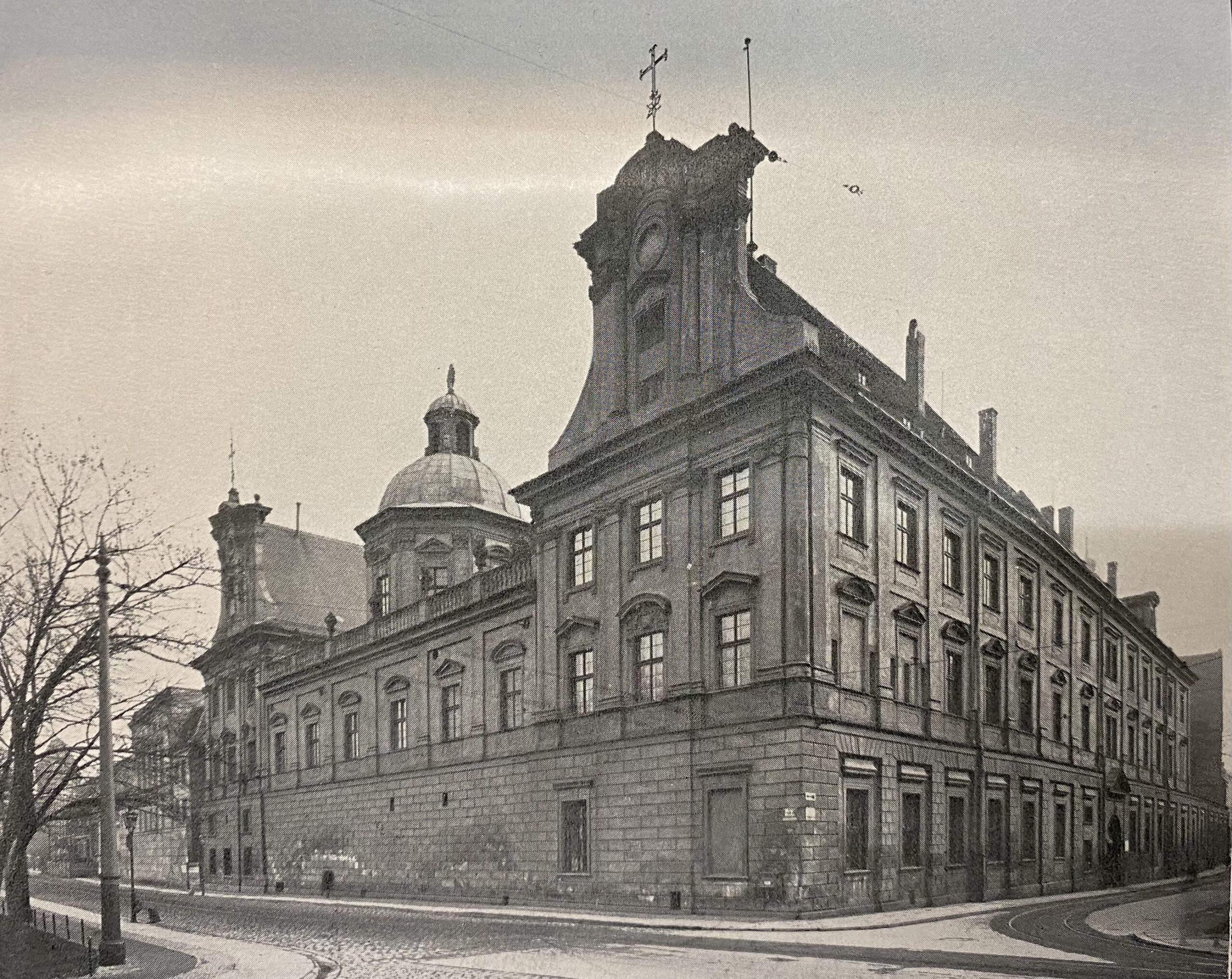
The Royal Catholic St. Matthias Gymnasium around 1910 (photo from the commemorative publication,
public domain)
public domain)
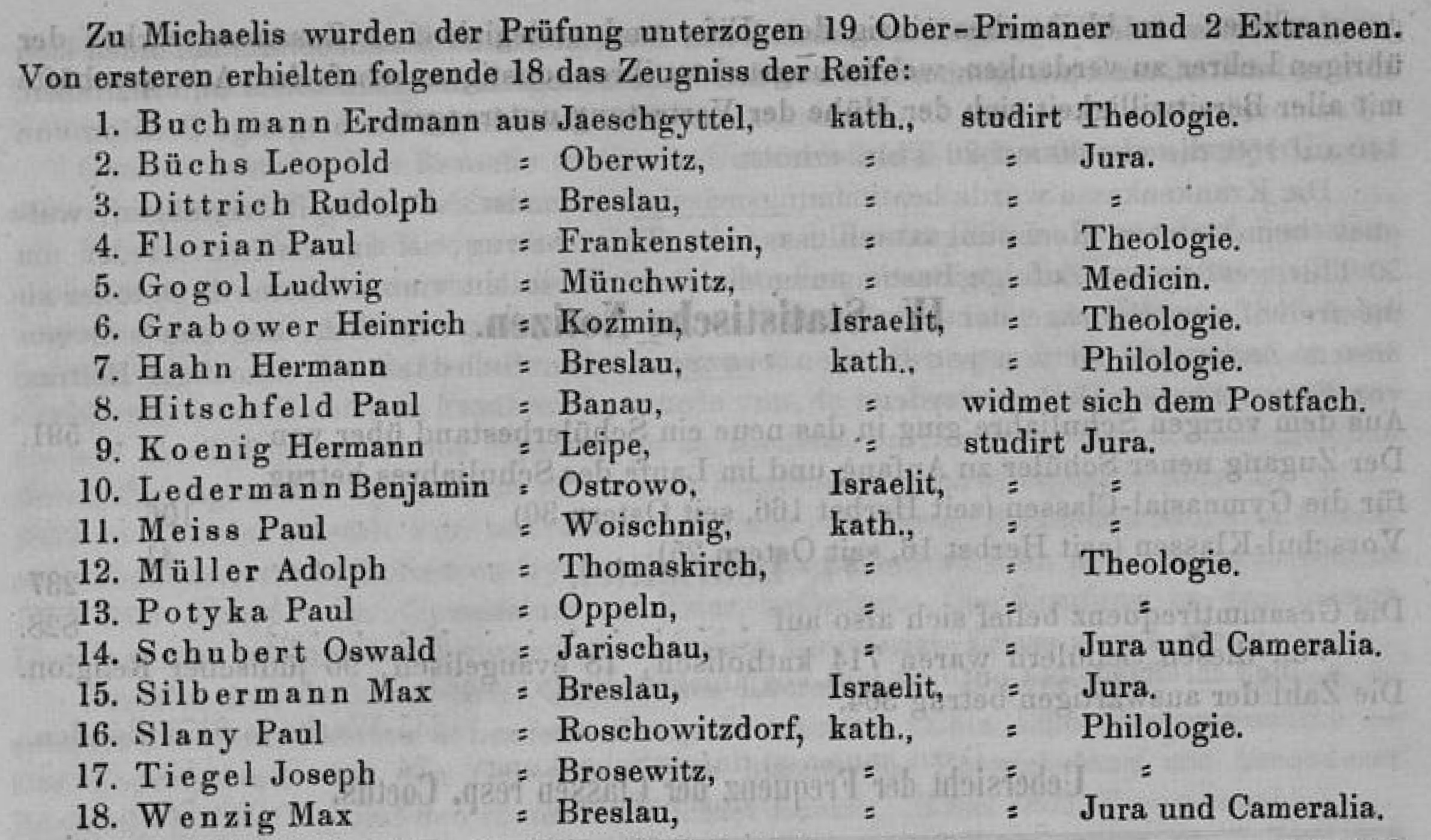
Graduates of the class of 1868 (from: Jahresbericht über das königliche katholische St. Matthias-Gymnasium für das Schuljahr 1867–1868. Breslau 1868, p. 28).
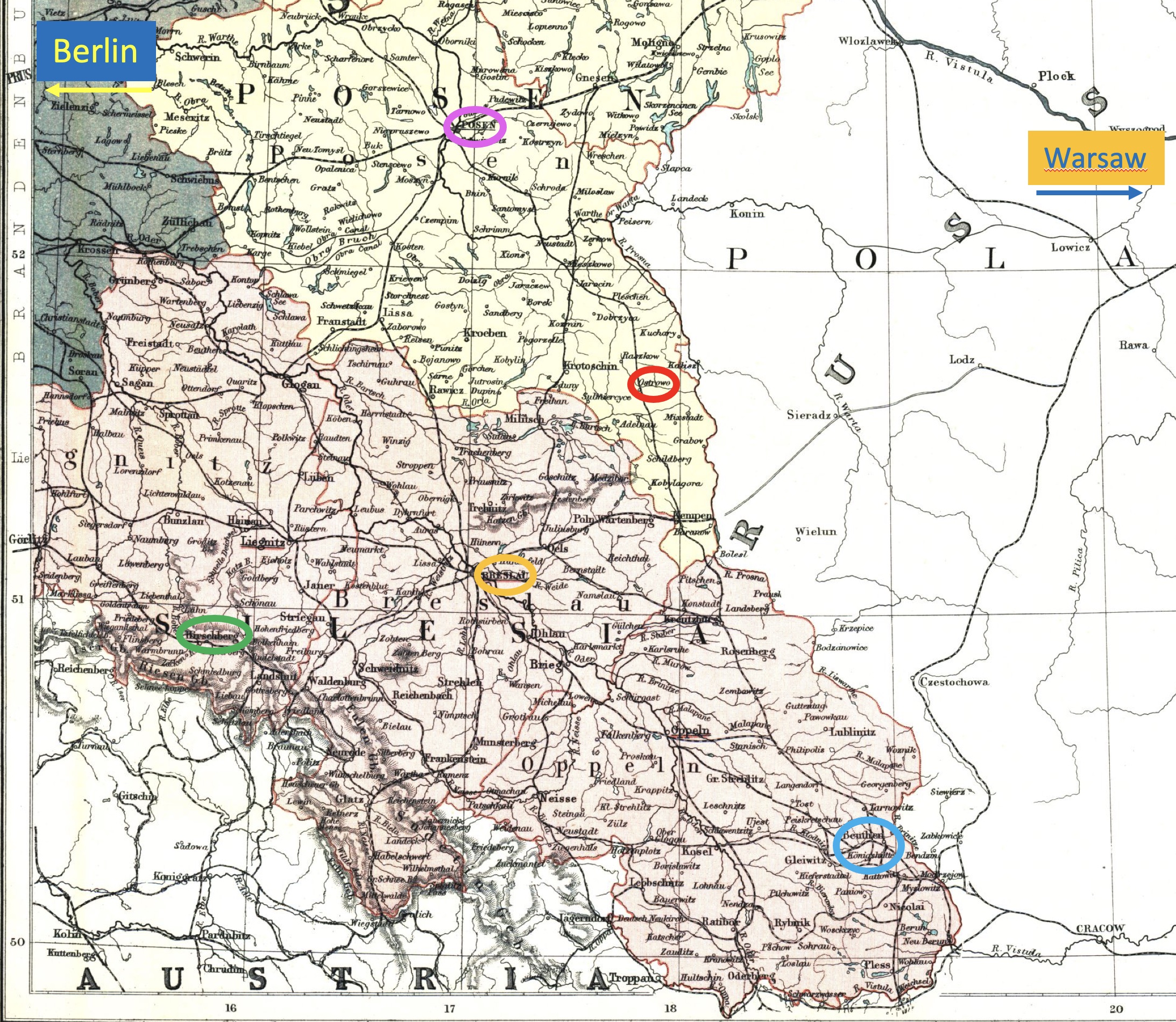
Map of the provinces of Posen and Silesia in the German Empire from 1875 (public domain). Marked in color are the towns of Posen, Ostrowo, Breslau, Beuthen, and Königshütte, as well as Hirschberg.

Advertisement in Israelitisches Familienblatt, 5th year, no. 26, 26 June 1902.
Article from Der Israelit 1911.

Death notices in Berliner Tagblatt, 20 June 1911.
Part 2.
weggum.com
Source: https://www.juele.eu/