DE ZAAK DESSING, DEEL 2.
D/CEM.1 to NL 2-12-43.
Regarding the matter of disposal of this student and the job waiting for him in the office of the Dutch Government. It is noted that this student was in the field from Februari 42 to September 43 and that since his return he has not re-entered training. D/CE agrees that that there is no need for L/CE.T. to interview this agent and a disposal form can be put through immediately for the consideration of MT and AD/E recommending transfer to employment with the Dutch Government.
From D.CE.M.1 to D/CE 3-12-43.
Stating the particulars regarding this student and recommending his release to the Dutch Army for employment.
APPLIC. FOR DISPENSING WITH STUDENT'S SERVICES.
Rank Civilian
Rank fic. 2/Lieut, Dutch Army in training
Rate of pay £ 22 per month.
£ 50 accumulated per month whilst in the field.
Commenced April 1941
Attended STS-4, STS-21, STS-51, STS-31, STST-61. No RCT.
Knowledge Considerable knowledge.
Departed for the field 27-2-1942.
Returned to this country 2-9-1943.
S???/Sec. As far as is known to N Section no student at present in
training is known to him as all have been recruited whilst he
was in the field.
Reas/Disp. It is considered definitely impossible to use this man again as
an agent in the field as he is most probably 'blown' there.
A work has been offered him in the Dutch Government it is
considered by this Section the best solution. He has arranged
to start work on 6-12-1943.
Country Section recommended disposal; Released to Dutch Government for work in civilian capacity Submitted to MT 2-12-1943. Recommended RTU. Submitted AD/E 2-12-1943. Recommended RTU.
D/CE's recommendation3-12-1943 Return Dutch Authorities.
C.D. decision: 13-12-1943. Sworn out 13-12-1943.
Remarks A stupid type of man. I cannot think that he will be security ??? is too unintelligent. Dessing was blamed for SOE's failures in Holland.
D/CEM.1 to D/CE 3-12-1943.
Giving particulars in brief regarding this student.
D/CE to PSO 10-12-1943.
This agent returned from Holland in September 1943. His interrogation showed a loyal and ineffective career. His case has been reconsidered in the light of recent events but nothing adverse appeared. The Dutch are employing him as a clerk in a non-confidential department of their Government.
D.CEM.1 to N 14-12-1943.
This student was sworn out by me on 13-12-1943 and returned to Dutch Government for work in a civilian capacity.
George Dessing had lost confidence in SOE completely and didn't want to work for them any longer.
After the war he was completely rehabilitated.
weggum.com
Regarding the matter of disposal of this student and the job waiting for him in the office of the Dutch Government. It is noted that this student was in the field from Februari 42 to September 43 and that since his return he has not re-entered training. D/CE agrees that that there is no need for L/CE.T. to interview this agent and a disposal form can be put through immediately for the consideration of MT and AD/E recommending transfer to employment with the Dutch Government.
From D.CE.M.1 to D/CE 3-12-43.
Stating the particulars regarding this student and recommending his release to the Dutch Army for employment.
APPLIC. FOR DISPENSING WITH STUDENT'S SERVICES.
Rank Civilian
Rank fic. 2/Lieut, Dutch Army in training
Rate of pay £ 22 per month.
£ 50 accumulated per month whilst in the field.
Commenced April 1941
Attended STS-4, STS-21, STS-51, STS-31, STST-61. No RCT.
Knowledge Considerable knowledge.
Departed for the field 27-2-1942.
Returned to this country 2-9-1943.
S???/Sec. As far as is known to N Section no student at present in
training is known to him as all have been recruited whilst he
was in the field.
Reas/Disp. It is considered definitely impossible to use this man again as
an agent in the field as he is most probably 'blown' there.
A work has been offered him in the Dutch Government it is
considered by this Section the best solution. He has arranged
to start work on 6-12-1943.
Country Section recommended disposal; Released to Dutch Government for work in civilian capacity Submitted to MT 2-12-1943. Recommended RTU. Submitted AD/E 2-12-1943. Recommended RTU.
D/CE's recommendation3-12-1943 Return Dutch Authorities.
C.D. decision: 13-12-1943. Sworn out 13-12-1943.
Remarks A stupid type of man. I cannot think that he will be security ??? is too unintelligent. Dessing was blamed for SOE's failures in Holland.
D/CEM.1 to D/CE 3-12-1943.
Giving particulars in brief regarding this student.
D/CE to PSO 10-12-1943.
This agent returned from Holland in September 1943. His interrogation showed a loyal and ineffective career. His case has been reconsidered in the light of recent events but nothing adverse appeared. The Dutch are employing him as a clerk in a non-confidential department of their Government.
D.CEM.1 to N 14-12-1943.
This student was sworn out by me on 13-12-1943 and returned to Dutch Government for work in a civilian capacity.
George Dessing had lost confidence in SOE completely and didn't want to work for them any longer.
After the war he was completely rehabilitated.
weggum.com
N/KV/410 24TH August 1943
To: D/RV From: N
On 23 Aug 1943 the attached photo-copy was handed by the Dutch "I" Service to the Dutch SOE, who passed on to me as it concerns our organiser CARROT (Dessing) who, as you know, is now on the way back to ENGLAND and is supposed to be in SPAIN at the present time.
I believe that this message has been received by the Belgian Surete and in order to check CARROT's story when he arrives here it will be of great use to me to know when the message left BELGIUM and when it was received here.
At the same time it would be interesting to know through what channels it reached the Dutch "I" Service and at what date, as the Dutch SOE believe that the Dutch "I" kept it for a long time. So far as I know, CARROT (DIRKSEN) has not been in BELGIUM for at least four months. Thecoded part is, I regret to say, indecipherable.
Would you please return the enclosure to me?
London,
27TH August 1943
Dear Seymour,
On the 23RD of this month I received via Major Lieftinck from Major Somer a note regarding Lieut. DIRKSEN and a coded message from the latter.
The message had obviously been written by a Belgian and all Major Somer knew about it was that he had received it that day from you.
It would be of the greatest interest to me to know when this message was written, when it arrived in this country and if possible through what channels it passed before it reached me.
I should be most grateful for any information you can give me on this subject.
E/3557. SECRET 27TH August, 1943
To: STS-HQ From: Commandant
(Attention Major Bingham) Group B.
With reference to Major Bingham's latter of the 24TH August, Capt. Benn states that the message from DIRKSEN reads as follows:
"INITIAL WORK HAS BEEN DONE SEA COMMUNICATION IMPOSSIBLE NO WIRELESS MAN HAS APPEARED AND THINGS HAVE GONE WRONG WITH MOST OF THE OTHER PARACHUTIST STOP HAVE IMPORTANT DOCUMENTS FOR DUTCH CABINET STOP ESSENTIAL COME BACK TO LONDON STOP AM THREE MONTHS IN BRUSSELS TRYING TO GET BACK STOP SEND INSTRUCTIONS THROUGH BELGIAN GOVERNMENT TO BRUSSELS FORM TWENTY THREE"
Capt. Benn states that this is definitely the rendering.
SOE could have known by the telegram that something was very wrong in Holland.
INTERROGATION OF CARROT.
Q. On arriving at this be N password not sufficient. Why? (Arriving at the safehouse of Miss Sara Lelie)
A. Photo and password given. Extra precaution against "Agent provocateur".
Q. How did he make contact with VAN LOOY?
A. This lady (Sara Lelie) kept in contact with VAN LOOY via VAN STAAL's daughter. Through her he made first contact
and afterwards kept in touch with the daughter of VAN STAAL, or went to VAN LOOY's private address.
Q. What work did he do with VAN LOOY?
A. Work included looking for landing grounds, safe houses, helpers and organisations which may be useful at a future
date.
Q. What was the name of the organisation in Amsterdam?
A. Name not known, nor names of its leaders.
Q. He stated that he could re-contact the organisation via ABRAHAMS. How?
A. ABRAHAMS was first introduced to him via VAN LOOY and he expected to make no future contacts via VAN LOOY.
Q. How did he make first contact with VAN STAAL?
A. VAN STAAL's daughter was in contact with Miss LELIE.
Q. What work did he do with VAN STAAL?
A. VAN STAAL was a great friend of VAN LOOY's and all worked together.
Q. Why did he hire a boarding house?
A. The boarding house was in a safe district and therefore free from suspicion and would make a goof safe house for
themselves, or any agents who would be dropped in the near future. (Which safe district, was there any?)
Q. Who was VAN MANEN?
A. He was afriend of VAN LOOY's who owned the boarding house.
Q. He arranged with VAN LOOY that on returning a broadcast message would be sent. What?
A. Once he had landed in England he would send a message through Radio Orange saying: "Gerrit van der Broek uw
familie en aanverwanten zijn wel". On hearing this message VAN LOOY would start to listen every Monday night on
Radio Orange until he received another message. This would mean he was returning, the message was to be: "Fia
gij zijt beter af met drie Britten". This meant that George (Dessing) would be returning three days after the Monday.
VAN LOOY would then arrange for a Reception Committee to receive George.
Q. VAN LOOY and George spent three weeks in Zwolle. Why?
A. VAN LOOY was well known in Zwolle, having a number of safe addresses and people willing to help him in case of an
emergency. George could give no names or addresses.
Q. Information wanted about the "Wervelwind".
A. He stated that the "Wervelwind" was a very popular paper, but was not evenly distributed. If five thousand copies
could be dropped in a bundle to him personally he and VAN LOOY would see to its proper distribution.
Q. Identity cards, stamps and workers.
A. Blank Identity cards would be very useful, as the ??? have a habit of collecting Identity cards and requesting the
owners to call for them at the police station. People could be found to fill in these identity cards, but stamps of the
larger towns e.g. Amsterdam, Groningen, etc would be very useful. Names of helpers not known.
Q. How did he first contact VORRINK?
A. This was done via VAN LOOY. VORRINK was a very useful man in getting information. George considered him
influential and well known to men of the large underground organisations in Holland. He had a number of
conferences with him, exchanging information about England and Holland.
Q. Who was the clergyman who lent him his room for the conferences?
A. George could give no names either of the priest or the church and just said that it was a room in an Cathlic pastorie
which was not then used.
Q. How did he first contact LIBAU in Brussels?
A. LIBAU worked in a factory in Rotterdam, VAN LOOY knew of him and first put George into touch with him.
Q. ANSEL. How was this first contacted?
A. George first got to know ANSEL after various friends had put him into touch with a safe address where he could stay
while he was in Brussels. He stayed there for about two months, hoping to obtain identity cards and money which
would enable him to escape back to England.
Q. How did George return to Holland after catching Scabien?
A. By the same route as he came.
Q. On returning to Brussels three weeks later, he went to Frau BIGGELAAN. Her husband is a voluntary worker in
Germany and so this address is not considered very safe.
Q. Who is the Jew who lent him the Fl.2000, 00 and how did this Jew find out about the work George was doing?
A. His name is DE GROOT. He was a very welathy man and a great friend of VAN LOOY. He did as much work as was
possible for people escaping to England.
Q. Who was the "famous Lawyer" MAERDENS?
A. This man was a very well known lawyer in Brussels who was a member of ANSEL. He was very helpful to George
and it was through him that he escaped from the country.
Q. Did he make any effort to contact DR. WYLER after his contact was broken?
A. He did not. He had no faith in letters to Switzerland and England and felt that this would take too much time, so
instead he decided to try to get back to England and begin over again.
Q. Did he make any effort to contact KUYPUS of the "International Federation of Trade Unions"?
A. No. He was asked to assist any influential men out of the country, but felt that this would be useless until he had
proper contact with England.
Q. How did he know of the parachutist (Molenaar) being killed?
A. This was from VORRINK.
Q. When did he see AKKERMAN (Andringa)?
A. On receiving the first broadcast message he went to meet his wireless operator, who did not turn up, but quite by
coincidence AKKERMAN came into the same café with another man. He warned george by signs that the man with
him was a Gestapo agent.
Q. Had VAN LOOY contacted with the wireless operator?
A. No. he had made some effort to contact with England via "Vrij Nederland" which was not successful.
Q. Could he give any names and addresses of people working with VAN LOOY?
A. Only one: JAN PIETERS from Zwolle.
Q. What reason could he give us for not using the Southern Route?
A. This is quite out of the question, as the islands concerned are well guarded and passes and documents are needed to
visit them (Zeeland en de Zuid Hollandse eilanden?)
Q. What work did he do in organising sabotage?
A. He found that small sets of sabotage were not popular and the people could not be interested in this way.
Q. Did he make any effort to contact BAREND VAN STAVEREN?
A. No. Boats were too stricktly controlled to be used.
14TH September 1943
MOVEMENTS OF CARROT
Started for Holland 27/28 February.
He contacted VAN LOOY via Mej. LELIE.
He was to contact MAARTENS (Molenaar) or JEFFERS (Jordaan), de Leische Poort Café every Monday afternoon after hearing broadcast.
Then to take a cut-out.
In case of failure to again wait for radio.
Told to contact Barend VAN STAVEREN at HELLEVOETSLUIS (fisherman).
If contact broken with England a letter to Dr. Veit Wyler in Switzerland would reach us.
He was to find anything about KEES VORRINK, SDAP?
He was to find anything about KUYPERS, Int. Fed. of Trade Uns.
Information required about old T.U. leaders, transport workers and seamen.
RADIO ORANGE.
"GEORGE is not to go to rendez-vous". Sent out 10TH, 11TH and 12TH March.
"GEORGE is to meet MAARTENS at RV". Sent 10TH and 12TH April.
"Een bericht voor GERRIT. U moet steeds proberen. Alles komt in orde". Sent out 10TH, 11TH, and 12TH May.
On 13TH April 1943 news from SIS (Mr. Jepson) that GEORGE has made contact with one of his agents. SIS not interested.
ADAMS telegraphs that GEORGE arrived in Switzerland on 10TH April, etc.
On 16TH April 1943 BERNE wires, GEORGE checked and is now with ADAMS' man in BASLE.
BERNE wires on 20TH April 1943, after MAY BBC GEORGE had seen A. (Andringa) at RV but was warned that GESTAPO was with him by A. No results from other messages. He left for BRUSSELS in September after not making any further contacts.
IN BRUSSELS he was in touch with a socialist organisation.
Plan made for him to get home wth two Belgium RAF pilots.
Left BRUSSELS on 10TH April to go to 33 via 53.
Arrived 53 on 11TH April.
On 24TH April GEORGE given address in PARIS, LYON or VALACE.
GEORGE due to leave on May 15TH and will be conducted to address.
On 24TH May 1943 BERNE says, address wash-out. On return held up by police.
Second journey more successful, after various escapades he arrived back in England.
INTERROGATION OF CARROT. 21ST September 1943.
MISSION.
Source was dropped in Holland at the end of February 1942, with the threefold mission of:
1. Examining and if possible establishing a sea route between that country and the UK.
2. Planning the escape of certain political personages to the UK.
3. Organising sabotage cells. (This was to have been the most important part of his work).
Owing to a series of setbacks for which he was himself in part responsible (how?). Source accomplished nothing but his own rather dreary ex-filtration through Switzerland and Spain. He was eventually brought back to this country by air from Gibraltar.
Source himself blames his failure on two things, viz:
1. He had no radio contact with England, and was never able to find anyone who had.
2. He was always short of money.
LANDING.
Source landed without mishap near ERMELO. He could not bury his parachute but hid it in the snow. He then found he was in a forbidden area, having been dropped near some German (SS) barracks, 3 km east of ERMELO. (Who selected this pinpoint?) He was not received by a reception committee, but took a compass bearing and set off by road. He made his way to AMSTERDAM, to the contact he had been given, the house of a Miss LELIE. here, however, they were not suffieciently satisfied with his credentials to put him in touch with an organisation until a radio message of 10TH, 11TH and 12TH March arrived to establish his integrity (A letter of introduction was received far too late!). After this he was put in touch with VAN LOOY, who was at that time doing subversive work in Holland, though believed by the Germans to have fled to England, as they had threatened him. He was a journalist and wrote for an underground newspaper called VERZET, this eventually petered out because it upheld a certain political party view, rather than a national one. The paper was published every fortnight and source helped VAN LOOY in the distribution of it, which he did by hand, having no money to hire transport. He was extremely vague about the process of distribution: his own part merely consisted of carrying bundles of copies to other people on a few occasions. He either could not or would not describe their ultimate distribution.
VAN LOOY was also concerned in supplying false idetity papers to to those who needed them. He was a friend of the Mayor, who was head of the local police as well, so he was able to steal the blank cards from his office. (Doubt this very much, Mayors were replaced by pro Nazi men)
Source remarks that Dutch identity cards have a very pronounced watermark, wheras the card made for him in London had a very weak one (The British were never able to produce a good Dutch identity card). He was not asked for this card, but if he had been, the watermark would probably have been queried. He was not, however, supplied with a better one by VAN LOOY, since only a few cards at the time could be stolen as described above and VAN LOOY needed these for more necessitous cases.
OTHER WORK.
In company with VAN LOOY, source also went into the country to seek out suitable landing grounds and found many, but having no contact with London. he thought he was abandoned and lost interest in his mission. On one occasion he went with VAN LOOY to ZWOLLE. Resistance was fairly strong in this town. It was there that the boycott of the German controlled V- en -V workers Movement started. The local workmen staged a fairly big strike in the STORCH factory, which deprived the whole district of electricity. Source distributed clandestine newspapers here. He found another suitable landing ground at WIJHE.
CONTACTS.
MAARTENS (Molenaar), the WT Operator whom source was to have contacted first, was killed on landing, and his alternative contact never kept the rendez-vous that was made for him with source. The third contact was ACKERMANN. When he came to his rendez-vous in the restaurant with source, he was accompanied by another man. Source signalled to ACKERMANN to go to the lavatory, which he did, but the other man went too. Afterwards the two of them left the restaurant together. ACKERMANN was walking behind the other man, and as he passed source wispered "GESTAPO". Source never saw him again, but when he reached Switzerland, he learned that ACKERMANN was dead (Andringa was killed at Mauthausen concentration camp in September 1944, see).
VAN LOOY introduced source to ABRAHAMS, a prominent lawyer in Amsterdam who was a member of a patriotic organisation to which he offered to source. As the organisation had neither money, arms or stores, source did not think he could do any good there and refused the contact. According to source ABRAHAMS is also in contact with one of our Agents (SIS)(Niermeijer?) sent out from the UK. Except that he is NOT a WT Operator, source can say nothing about this man. Asked why he did not request ABRAHAMS to put him in touch with this Agent, source had no convincing answer but said that for reasons of security this was not done. Source them met VAN STAAL, who had an advertising firm in Amsterdam (address: Amstelkade 154.) He knew a great many people and was a useful man for contacts. At one time he had been very wealthy. (Kan het zijn dat Abrahams Carel Abrahams is?) See timeline 1942.
VAN STAAL had a married daughter who acted as courier for VORRINK, a former president of the SDAP, which is officially recognised by the Dutch government in London. VORRINK was in touch with all the military and political leaders in London but had nothing to do with the ORDE DIENST. According to source, the ORDE DIENST was an entirely or mainly military organisation. It had thousands of members all over the place and no idea of security at all. Whilst source was in Holland, more than 100 of its members were shot. These members were neither at the top nor at the bottom of the organisation, but rather in the middle stratum. Source seemed to think that the Germans had deliberately left the leading members for later on. VORRINK was also in touch with VRIJ NEDERLAND, a patriotic party which also had a newspaper of that name. His contact with that organisation was a former KLM pilot. Source tried to get a message to London through this organisation, but nothing came of it. Before he left Holland, source learned that VORRINK did know of one WT Operator in the country, whose set had, however, broken down. Source does not appear to have persued this matter any further.
CAREL ABRAHAMS. Executed by firing squad. BRONZE CROSS:
“Distinguished himself by courageous conduct towards the enemy by, immediately after the capitulation of the Netherlands in 1940, on the one hand joining the collaborators of an intelligence group and on the other hand participating in the organization of resistance groups. In particular by gathering several important military details about the enemy and establishing a connection with England and Switzerland. Finally, when in August 1942 he attempted, through this channel, to send an important document concerning the economic and further situation in the Netherlands and he, presumably through betrayal, was arrested in his office while still in possession of this document, he remained silent during the secret trial until he was executed by firing squad in August 1943. By this conduct rendering important services to the Allied war effort and the Dutch Government.”
On August 4, 1942 he was arrested for espionage. During his arrest, a pistol was also retrieved from behind the bookcase. For the family, this was proof that betrayal had been involved. After his arrest he was taken to the prison on the Amstelveenseweg in Amsterdam. After interrogations by the Gestapo (SiPo) at 63 Euterpestraat in Amsterdam, he was transferred for several weeks to the prison located on Gansstraat in Utrecht. He spent the last days of his life in the prison on Weteringschans in Amsterdam, where his family was able to visit him briefly.
The lieutenant did not belong to a specific organization but worked together with former military officers on military actions and maintained contacts with the British Intelligence Service and the Berichten Dienst (BeDi).
On June 19, 1945, five bodies were found while excavating the bullet catcher at the shooting range near Schiphol, behind Colijn’s farm on the Aalsmeerderweg. Two of the victims were identified, among them Carel Abrahams.
Source stayed for two months at Miss LELIE's house but thought it was unsafe to remain there any longer since the LELIE sisters are Jewish. He says that they have now become inmates of a lunatic asylum in order to avoid being sent to Poland and that their house is closed. Source hired for the summer a small house near VIERHOUTEN and found a suitable landing ground near it, but once again he could do nothing as he had no contact with the UK. (Vierhouten is a sparsely populated dictrict, conditions are primitive and the Germans do not go there much). The owner of the house, VAN MANEN, a former Youth Movement Leader, was friendly with another Youth Movement Leader named JAN PEETERS, who was also doing resistance work. Source thinks that both material and personnel could safely be landed at VIERHOUTEN. He would like to be dropped there himself if he returns to Holland.
SABOTAGE OPPERTUNITIES NOT INVESTIGATED.
Since he had no explosives and no means of communication, source thought it idle to try to form sabotage cells and took no steps in this direction.
NO POSSIBILITY OF SEA ROUTE.
Part of source's mission was also to investigate the possibility of a sea route. He reports that this was not possible at all. No one is allowd in the islands without the express permission of the Germans; he must then state his reason for going there and estimate the number of days he will stay. Coast guards patrol on the shore and no boat of any kind is permitted . (This information is entirely hearsay. Source was told he would not be able to get anywhere near the coast and so made no attempt to go and see for himself what matters were like. He expressed the opinion that for an important ex-filtration MTB's might make a dash for it but his views on this subject would appear to be of no value.
SOURCE NOT ABLE TO HELP ESCAPES.
Source was aloso to help some people out of the country to the UK, but having no escape route himself, no money and no contacts, he could not do so.
JOURNEY TO BELGIUM.
Source was landed with 7.000 Gulden and borrowed 2.000 more. The first time he went to Belgium, he went by bicycle from ROOSENDAAL. A Director of the SHELL OIL Co. in Rotterdam whose name he cannor (or will not) remember, put him in touch with JOFF LIBAU of ROOSENDAAL. LIBAU's sister, Mme. v.d. BIGGELAAR, married to a poor chemist in the Rue Marche du Park, Brussels, often made the trip to Holland (illegally). She had two identity cards, one Dutch and one Belgium (by her marriage). Her husband has now volunteerd to go to work in Germany. She meet source in ROOSENDAAL and they went together towards HUIBERGEN. Two km away from this village and just off the road there is a farm, partly in Holland and partly in Belgium and here they crossed the frontier. He stayed with Mme. v.d. BIGGELAAR in Brussels and there contacted a socialist named VAN OVERLOOP, a member of the ANSEL organisation. This man got him a Belgian identity papers in the name of JAN PEETERS (the Youth Leader from VIERHOUTEN). This showed him to have been born at VILMVOORDE, near ANTWERP. Fortunately source was never asked to produce this card. After some weeks in Brussels source felt ill and returned to Amsterdam to see a doctor. He is vague about the date of his econd visit to Belgium, but thinks is was some time in October. He crossed the frontier in the same place as before. This time there was a German sentry near the farm, but source bicycled rapidly away from him without being molested. This was in broad daylight and source thinks the sentry must have taken him for one of the regular farmworkers. Before leaving Holland, he borrowed some more oney, this time from a Jew called DE GROOT, who was at the time very well off and had been known to help refugees. Source stayed at the same address in Brussels as before (Rue Marche de Park) till people began to talk. He then got into touch with Monsieur SIMONS, who is himself in touch with the Dutch authorities in London. Source gave no particulars of SIMON's organisation, nor of SIMON's ostensible occupation in Brussels, but said that through SIMON' organisation he was able to live for two months in a boardinghouse largely frequented by Germans.
He posed as refugee here, but is unable to give the address of the boardinghouse. He moved to GROENENDAAL, a well-known lawyer, who finally got him away to Switzerland. (Who was this lawyer?)
See https://nieuwesuikerhofje.nl/dick-van-stokkum/
ATTEMPT TO STEAL A GERMAN AIRCRAFT.
MAERDENS was at that time concerned with two Belgian pilots from the RAF who had been specially dropped in order to try and steal a certain German fighter plane, which was known to carry a new type of D/F apparatus. The attempt failed and 48 people were arrested. Source last heard of the pilots in hiding. This would be in February or March.
JOURNEY TO SWITZERLAND.
After the Germans occupied the South of France, escape routes became very difficult. SIMONS left for Geneva and 14 days later, source followed him. He gor from Brussles to Switzerland in 24 hours, via Paris, still travelling on an identity card in the name of JAN PEETERS. His companion was a young Swiss girl in the Swiss Intelligence Service, who travelled about a lot and knew where the contols were to be expected. they got off the train at BELFORT, whence they went by bus to a little place near the Swiss frontier. They got a guide and crossed the frontier by night. Once across, source was handed over to a Swiss customs official, who was quite sympathetic and took him by car to PORRENTRUY. From here he got in touch with FRANCKEN at BASLE. He was very lucky and met with no controls in the trains except at the Franco-Belgian border. On this occasion there were two smugglersin the carriage with source, who had their clothes stuffed with tabacco. Having found this, the French officials proceeded to search source. Before he left Holland (? for the second time) VORRINK had given him some important papers for transmission to the Dutch government in London. (Source is anxious to talk to highly placed officials about thesedispatches). They were in the form of very small photographs and source sewed them on teh back of his trousers between his brace buttons. Although the Customs officials searched him thoroughly all over and made him take off his boots, they did not find these documents. Incidentally, the carriage of these papers to London was the only task VORRINK gave source to do for him.
PRISON IN FRANCE.
After some weeks in Switzerland, source went back to France, to Lyon, but was unable to trace the contact which he had been given. An inspector of the French police acted as his guide. Returning from Lyon, they got as far as ST. JULIEN by bus, when source was arrested. He was questioned minutely and told a long tale about being a refigee from Holland and having spent all his money on bribes and passes (he had to explain the fact that he was quite without money somehoe). he gave the name of VAN DAMM, which was on the new papers he had been given in Switzerland: he says the officials believed him. He was taken to ANNECY and placed in prison where he contacted a Russian who was able to borrow some money for him. He was taken back to ST. JULIEN after a few days and condemed to eight days in prison for "dissiimulation d' indentite". He was then allowed to go to a hotel, but supposed to report to the police every day. he was supplied with identity card, ration card, tabacco ration card etc. by the police. After a few days at the hotel, he contacted the Russian again and they started for Switzerland together. The Russian had a daughter employed in a cabaret in Switzerland under the name of TAMARA YORK, and at his direction, source had written to her from prison. The letter was posted for him outside by a released prisoner and apparently reached its destination.
They left by car, the continued on foot until they met their guide as arranged. The guide left them at night, and they walked on by themselves until they got lost. They struck the frontier in the middle of the night, soaking wet, and were hailed by an Italian on guard. For some reason he allowed them to cross over, possibly fearing they were armed. Source has never heard of the MARC organisation, which is mentioned in the BERNE telegram of the 14-4-1943.
GERMAN & DUTCH CONTROLS IN HOLLAND.
Source thinks that the Germans in Holland are very stupid. They are not first class troops; most of them have seen service in Russia. There is not a great deal of fear from them when they make controls etc. The older men of the Dutch police are mostely pro-Allied, but the younger men are Nazi-recruited and can be very dangerous. Referring to the distribution of newspapers by hand, source agreed that it was dangerous to be seen in Amsterdam carrying a parcel or a suitcase, as one would immediately be suspected of black market traffic, which has now reached immense proportions.
CURRENCY.
According to source, the 500 and 1000 Gulden banknotes are no longer currency, not even in the black market, as it is known there is no confidence in Dutch currency generally. All business houses are German controlled and money cannot be withdrawn from them. There is a great demand for jewels etc and for Sterling and American dollars, which are bought, when available, above par.
CLOTHING.
The quality of clothing is poor. A suit in the black market costs between 300 and 400 Gulden. Source was able to buy a pair of shoes "cheap" through Miss LELIE for 50 Gulden. The Germans are buying up diamonds wherever possible; the principal vendors are Jews, who need the money to live at all and to escape to neutral countries. the German troops are fairly well clothed.
FOOD.
The food position is very bad and getting worse. One can still eat well in the black market, if one can afford it. Quenen form outside the shops before dawn. The position is better in the country than in the towns. Even the Germans are forced to eat in the black market if they want a good meal. In Westland, the Germans have been known to raid the market gardens for food.
WIRELESS SETS.
All wireless sets have to be registered with the police in Holland. It is not possible to keep a set secret unless one has two sets and only registered one.
FACTORIES.
Questioned about suitable targets for bombing in Holland, source suggested the FORD works at AMSTERDAM, as they are engaged in turning out trucks for the Germans. Also the WERKSPOOR in AMSTERDAM, HAARLEM and UTRECHT, who build railway wagons. (Particularly the plant at UTRECHT, which is the largest of the three) He said we should NOT bomb the HEMBRUG arms factory, as there are many of our own people inside, and it was of use to local patriots who wanted repaire and replacements of weapons.
AIRCRAFT and AIRFIELDS.
There were not many German aircraft left in Holland last autumn. Several of the principal airfields were unusable for heavy bombers as the Germans insisted on enlarging them when they took over Holland, and filled in all the drainage channels. The ground is now soggy in consequence. Most of the German fighters were stationed at WOENSDRECHT. SOESTERBERG was still in use and well defended. LEEUWARDEN was also still in use.
On this subject, as on so many others, source seemed to be singularly ii-informed. He did not mention, for instance, the airfields of DEELEN and EINDHOVEN, which were important bomber stations during his stay in Holland. Nor did he mention the fighter station at VENLO. Although he spent much of his time near AMSTERDAM, he has nothing to say about SCHIPHOL.
DCEGA/KV/694. 22ND September 1943.
To: N. From: D/CE GA
Attached (Lieftinck) please find a copy of the interrogation of CARROT. I could not help regarding this man with some little suspicion. While I have no reason to suppose that he is telling lies, it is perfectly obvious that he is not telling the whole truth: either because his memory is quite hopeless, or because he does not choose to do so.
Although he claims to have been nearly always short of money and says that the food situation in Holland is very bad, unless one is prepared to pay highly in the black market, he nevertheless informs me that he never went hungry the whole time he was there. It is also odd that he says he stayed for two months at a boarding house in Brussels that was used largely by Germans, he cannot give me the address. Nor does he give me any information about SIMON's actual or ostensible activities, although he appears to have seen him a good many times. In almost every instance where he might be able to help with particulars of some useful contact e.g. the Director of the Shell Co. in Rotterdam, he claims either to have forgotten or never to have heard the name.
I have formed the impression that CARROT's reticence is probably due to the fact that he did practically nothing in Holland and is rather ashamed of it although one cannot conclude the ... no more text available.
DCEGA/KV/780 2ND October 1943.
To: N. From: D/GE.GA.
CARROT
I have asked the L.R.C. for look-ups on:
ABRAHAMS
VAN STAAL
Tom VAN MANEN
Jan PEETERS
Joff LIBAU
Mme. VAN DEN BIGGELAAR
VAN OVERLOOP
SIMONS
MAERDENS
There is no likely trace of any of them, but you may be interested in the following trace on SIMONS. This obviously does not agree with the man described by CARROT, but nevertheless may be of some use to you.
SIMONS ? identical with:-
Joachim SIMONS @ VAN ES. German Jew. Aged about 50; 170 cm; slim; black hair; dark eyes; wears spectacles; leans forwards when he walks. His wife Sophie nee VAN COEVORDEN is now in Switzerland.
Is believed to have moved to Holland at the end of 1938. He worked for some time at a farm and then transferred to the Jewish village WIENINGERMEER. He then became chief of the instruction centre at LOOSDRECHT until this was closed down in July 1942.
Up to January 1943 he was concerned with an individual of Rotterdam known as "JOOP" in providing hiding places for boys and girls under military age and SIMONS travelled several times to Belgium and France to prepare an ... no more text available.
Sophie Adina van Coevorden was born on May 23, 1917 in Coevorden, the Netherlands. She joined the “HeChalutz” movement in Amsterdam after her high school graduation and there she met Uri - Walter Kochba - Koch who arrived in the Netherlands as an immigration emissary. In years to come he would be her lifelong partner.
After the occupation of the Netherlands by the Germans, Sophie went underground and married Simon Joachim - Yachin "Schuschu", one of the founders of the pioneers’ underground, the "Westerweel Group" and one of its leaders.
In October 1942 Sophie was smuggled by “Schuschu” to Switzerland where she stayed in Versoix and held a correspondence with her “HeChalutz” friends in the Netherlands which continued throughout the war.
She was also engaged in instructing Jewish youths. Schuschu was captured on his way back to the Netherlands after smuggling her to Switzerland. He was imprisoned at Breda prison and after being severely tortured he committed suicide without exposing his friends.
In 1945 Adina renewed her relationship with Uri Kochba. She immigrated to Eretz Israel after the war through France & Spain. On June 16, 1945, she arrived in Eretz Israel and was sent to Atlit camp. With the help of Moshe Rabinowicz & Moshe Kliger she was released. She moved to Ra’anana and in 1946 she joined Uri in Na’an where they built their family.
To: D/RV From: N
On 23 Aug 1943 the attached photo-copy was handed by the Dutch "I" Service to the Dutch SOE, who passed on to me as it concerns our organiser CARROT (Dessing) who, as you know, is now on the way back to ENGLAND and is supposed to be in SPAIN at the present time.
I believe that this message has been received by the Belgian Surete and in order to check CARROT's story when he arrives here it will be of great use to me to know when the message left BELGIUM and when it was received here.
At the same time it would be interesting to know through what channels it reached the Dutch "I" Service and at what date, as the Dutch SOE believe that the Dutch "I" kept it for a long time. So far as I know, CARROT (DIRKSEN) has not been in BELGIUM for at least four months. Thecoded part is, I regret to say, indecipherable.
Would you please return the enclosure to me?
London,
27TH August 1943
Dear Seymour,
On the 23RD of this month I received via Major Lieftinck from Major Somer a note regarding Lieut. DIRKSEN and a coded message from the latter.
The message had obviously been written by a Belgian and all Major Somer knew about it was that he had received it that day from you.
It would be of the greatest interest to me to know when this message was written, when it arrived in this country and if possible through what channels it passed before it reached me.
I should be most grateful for any information you can give me on this subject.
E/3557. SECRET 27TH August, 1943
To: STS-HQ From: Commandant
(Attention Major Bingham) Group B.
With reference to Major Bingham's latter of the 24TH August, Capt. Benn states that the message from DIRKSEN reads as follows:
"INITIAL WORK HAS BEEN DONE SEA COMMUNICATION IMPOSSIBLE NO WIRELESS MAN HAS APPEARED AND THINGS HAVE GONE WRONG WITH MOST OF THE OTHER PARACHUTIST STOP HAVE IMPORTANT DOCUMENTS FOR DUTCH CABINET STOP ESSENTIAL COME BACK TO LONDON STOP AM THREE MONTHS IN BRUSSELS TRYING TO GET BACK STOP SEND INSTRUCTIONS THROUGH BELGIAN GOVERNMENT TO BRUSSELS FORM TWENTY THREE"
Capt. Benn states that this is definitely the rendering.
SOE could have known by the telegram that something was very wrong in Holland.
INTERROGATION OF CARROT.
Q. On arriving at this be N password not sufficient. Why? (Arriving at the safehouse of Miss Sara Lelie)
A. Photo and password given. Extra precaution against "Agent provocateur".
Q. How did he make contact with VAN LOOY?
A. This lady (Sara Lelie) kept in contact with VAN LOOY via VAN STAAL's daughter. Through her he made first contact
and afterwards kept in touch with the daughter of VAN STAAL, or went to VAN LOOY's private address.
Q. What work did he do with VAN LOOY?
A. Work included looking for landing grounds, safe houses, helpers and organisations which may be useful at a future
date.
Q. What was the name of the organisation in Amsterdam?
A. Name not known, nor names of its leaders.
Q. He stated that he could re-contact the organisation via ABRAHAMS. How?
A. ABRAHAMS was first introduced to him via VAN LOOY and he expected to make no future contacts via VAN LOOY.
Q. How did he make first contact with VAN STAAL?
A. VAN STAAL's daughter was in contact with Miss LELIE.
Q. What work did he do with VAN STAAL?
A. VAN STAAL was a great friend of VAN LOOY's and all worked together.
Q. Why did he hire a boarding house?
A. The boarding house was in a safe district and therefore free from suspicion and would make a goof safe house for
themselves, or any agents who would be dropped in the near future. (Which safe district, was there any?)
Q. Who was VAN MANEN?
A. He was afriend of VAN LOOY's who owned the boarding house.
Q. He arranged with VAN LOOY that on returning a broadcast message would be sent. What?
A. Once he had landed in England he would send a message through Radio Orange saying: "Gerrit van der Broek uw
familie en aanverwanten zijn wel". On hearing this message VAN LOOY would start to listen every Monday night on
Radio Orange until he received another message. This would mean he was returning, the message was to be: "Fia
gij zijt beter af met drie Britten". This meant that George (Dessing) would be returning three days after the Monday.
VAN LOOY would then arrange for a Reception Committee to receive George.
Q. VAN LOOY and George spent three weeks in Zwolle. Why?
A. VAN LOOY was well known in Zwolle, having a number of safe addresses and people willing to help him in case of an
emergency. George could give no names or addresses.
Q. Information wanted about the "Wervelwind".
A. He stated that the "Wervelwind" was a very popular paper, but was not evenly distributed. If five thousand copies
could be dropped in a bundle to him personally he and VAN LOOY would see to its proper distribution.
Q. Identity cards, stamps and workers.
A. Blank Identity cards would be very useful, as the ??? have a habit of collecting Identity cards and requesting the
owners to call for them at the police station. People could be found to fill in these identity cards, but stamps of the
larger towns e.g. Amsterdam, Groningen, etc would be very useful. Names of helpers not known.
Q. How did he first contact VORRINK?
A. This was done via VAN LOOY. VORRINK was a very useful man in getting information. George considered him
influential and well known to men of the large underground organisations in Holland. He had a number of
conferences with him, exchanging information about England and Holland.
Q. Who was the clergyman who lent him his room for the conferences?
A. George could give no names either of the priest or the church and just said that it was a room in an Cathlic pastorie
which was not then used.
Q. How did he first contact LIBAU in Brussels?
A. LIBAU worked in a factory in Rotterdam, VAN LOOY knew of him and first put George into touch with him.
Q. ANSEL. How was this first contacted?
A. George first got to know ANSEL after various friends had put him into touch with a safe address where he could stay
while he was in Brussels. He stayed there for about two months, hoping to obtain identity cards and money which
would enable him to escape back to England.
Q. How did George return to Holland after catching Scabien?
A. By the same route as he came.
Q. On returning to Brussels three weeks later, he went to Frau BIGGELAAN. Her husband is a voluntary worker in
Germany and so this address is not considered very safe.
Q. Who is the Jew who lent him the Fl.2000, 00 and how did this Jew find out about the work George was doing?
A. His name is DE GROOT. He was a very welathy man and a great friend of VAN LOOY. He did as much work as was
possible for people escaping to England.
Q. Who was the "famous Lawyer" MAERDENS?
A. This man was a very well known lawyer in Brussels who was a member of ANSEL. He was very helpful to George
and it was through him that he escaped from the country.
Q. Did he make any effort to contact DR. WYLER after his contact was broken?
A. He did not. He had no faith in letters to Switzerland and England and felt that this would take too much time, so
instead he decided to try to get back to England and begin over again.
Q. Did he make any effort to contact KUYPUS of the "International Federation of Trade Unions"?
A. No. He was asked to assist any influential men out of the country, but felt that this would be useless until he had
proper contact with England.
Q. How did he know of the parachutist (Molenaar) being killed?
A. This was from VORRINK.
Q. When did he see AKKERMAN (Andringa)?
A. On receiving the first broadcast message he went to meet his wireless operator, who did not turn up, but quite by
coincidence AKKERMAN came into the same café with another man. He warned george by signs that the man with
him was a Gestapo agent.
Q. Had VAN LOOY contacted with the wireless operator?
A. No. he had made some effort to contact with England via "Vrij Nederland" which was not successful.
Q. Could he give any names and addresses of people working with VAN LOOY?
A. Only one: JAN PIETERS from Zwolle.
Q. What reason could he give us for not using the Southern Route?
A. This is quite out of the question, as the islands concerned are well guarded and passes and documents are needed to
visit them (Zeeland en de Zuid Hollandse eilanden?)
Q. What work did he do in organising sabotage?
A. He found that small sets of sabotage were not popular and the people could not be interested in this way.
Q. Did he make any effort to contact BAREND VAN STAVEREN?
A. No. Boats were too stricktly controlled to be used.
14TH September 1943
MOVEMENTS OF CARROT
Started for Holland 27/28 February.
He contacted VAN LOOY via Mej. LELIE.
He was to contact MAARTENS (Molenaar) or JEFFERS (Jordaan), de Leische Poort Café every Monday afternoon after hearing broadcast.
Then to take a cut-out.
In case of failure to again wait for radio.
Told to contact Barend VAN STAVEREN at HELLEVOETSLUIS (fisherman).
If contact broken with England a letter to Dr. Veit Wyler in Switzerland would reach us.
He was to find anything about KEES VORRINK, SDAP?
He was to find anything about KUYPERS, Int. Fed. of Trade Uns.
Information required about old T.U. leaders, transport workers and seamen.
RADIO ORANGE.
"GEORGE is not to go to rendez-vous". Sent out 10TH, 11TH and 12TH March.
"GEORGE is to meet MAARTENS at RV". Sent 10TH and 12TH April.
"Een bericht voor GERRIT. U moet steeds proberen. Alles komt in orde". Sent out 10TH, 11TH, and 12TH May.
On 13TH April 1943 news from SIS (Mr. Jepson) that GEORGE has made contact with one of his agents. SIS not interested.
ADAMS telegraphs that GEORGE arrived in Switzerland on 10TH April, etc.
On 16TH April 1943 BERNE wires, GEORGE checked and is now with ADAMS' man in BASLE.
BERNE wires on 20TH April 1943, after MAY BBC GEORGE had seen A. (Andringa) at RV but was warned that GESTAPO was with him by A. No results from other messages. He left for BRUSSELS in September after not making any further contacts.
IN BRUSSELS he was in touch with a socialist organisation.
Plan made for him to get home wth two Belgium RAF pilots.
Left BRUSSELS on 10TH April to go to 33 via 53.
Arrived 53 on 11TH April.
On 24TH April GEORGE given address in PARIS, LYON or VALACE.
GEORGE due to leave on May 15TH and will be conducted to address.
On 24TH May 1943 BERNE says, address wash-out. On return held up by police.
Second journey more successful, after various escapades he arrived back in England.
INTERROGATION OF CARROT. 21ST September 1943.
MISSION.
Source was dropped in Holland at the end of February 1942, with the threefold mission of:
1. Examining and if possible establishing a sea route between that country and the UK.
2. Planning the escape of certain political personages to the UK.
3. Organising sabotage cells. (This was to have been the most important part of his work).
Owing to a series of setbacks for which he was himself in part responsible (how?). Source accomplished nothing but his own rather dreary ex-filtration through Switzerland and Spain. He was eventually brought back to this country by air from Gibraltar.
Source himself blames his failure on two things, viz:
1. He had no radio contact with England, and was never able to find anyone who had.
2. He was always short of money.
LANDING.
Source landed without mishap near ERMELO. He could not bury his parachute but hid it in the snow. He then found he was in a forbidden area, having been dropped near some German (SS) barracks, 3 km east of ERMELO. (Who selected this pinpoint?) He was not received by a reception committee, but took a compass bearing and set off by road. He made his way to AMSTERDAM, to the contact he had been given, the house of a Miss LELIE. here, however, they were not suffieciently satisfied with his credentials to put him in touch with an organisation until a radio message of 10TH, 11TH and 12TH March arrived to establish his integrity (A letter of introduction was received far too late!). After this he was put in touch with VAN LOOY, who was at that time doing subversive work in Holland, though believed by the Germans to have fled to England, as they had threatened him. He was a journalist and wrote for an underground newspaper called VERZET, this eventually petered out because it upheld a certain political party view, rather than a national one. The paper was published every fortnight and source helped VAN LOOY in the distribution of it, which he did by hand, having no money to hire transport. He was extremely vague about the process of distribution: his own part merely consisted of carrying bundles of copies to other people on a few occasions. He either could not or would not describe their ultimate distribution.
VAN LOOY was also concerned in supplying false idetity papers to to those who needed them. He was a friend of the Mayor, who was head of the local police as well, so he was able to steal the blank cards from his office. (Doubt this very much, Mayors were replaced by pro Nazi men)
Source remarks that Dutch identity cards have a very pronounced watermark, wheras the card made for him in London had a very weak one (The British were never able to produce a good Dutch identity card). He was not asked for this card, but if he had been, the watermark would probably have been queried. He was not, however, supplied with a better one by VAN LOOY, since only a few cards at the time could be stolen as described above and VAN LOOY needed these for more necessitous cases.
OTHER WORK.
In company with VAN LOOY, source also went into the country to seek out suitable landing grounds and found many, but having no contact with London. he thought he was abandoned and lost interest in his mission. On one occasion he went with VAN LOOY to ZWOLLE. Resistance was fairly strong in this town. It was there that the boycott of the German controlled V- en -V workers Movement started. The local workmen staged a fairly big strike in the STORCH factory, which deprived the whole district of electricity. Source distributed clandestine newspapers here. He found another suitable landing ground at WIJHE.
CONTACTS.
MAARTENS (Molenaar), the WT Operator whom source was to have contacted first, was killed on landing, and his alternative contact never kept the rendez-vous that was made for him with source. The third contact was ACKERMANN. When he came to his rendez-vous in the restaurant with source, he was accompanied by another man. Source signalled to ACKERMANN to go to the lavatory, which he did, but the other man went too. Afterwards the two of them left the restaurant together. ACKERMANN was walking behind the other man, and as he passed source wispered "GESTAPO". Source never saw him again, but when he reached Switzerland, he learned that ACKERMANN was dead (Andringa was killed at Mauthausen concentration camp in September 1944, see).
VAN LOOY introduced source to ABRAHAMS, a prominent lawyer in Amsterdam who was a member of a patriotic organisation to which he offered to source. As the organisation had neither money, arms or stores, source did not think he could do any good there and refused the contact. According to source ABRAHAMS is also in contact with one of our Agents (SIS)(Niermeijer?) sent out from the UK. Except that he is NOT a WT Operator, source can say nothing about this man. Asked why he did not request ABRAHAMS to put him in touch with this Agent, source had no convincing answer but said that for reasons of security this was not done. Source them met VAN STAAL, who had an advertising firm in Amsterdam (address: Amstelkade 154.) He knew a great many people and was a useful man for contacts. At one time he had been very wealthy. (Kan het zijn dat Abrahams Carel Abrahams is?) See timeline 1942.
VAN STAAL had a married daughter who acted as courier for VORRINK, a former president of the SDAP, which is officially recognised by the Dutch government in London. VORRINK was in touch with all the military and political leaders in London but had nothing to do with the ORDE DIENST. According to source, the ORDE DIENST was an entirely or mainly military organisation. It had thousands of members all over the place and no idea of security at all. Whilst source was in Holland, more than 100 of its members were shot. These members were neither at the top nor at the bottom of the organisation, but rather in the middle stratum. Source seemed to think that the Germans had deliberately left the leading members for later on. VORRINK was also in touch with VRIJ NEDERLAND, a patriotic party which also had a newspaper of that name. His contact with that organisation was a former KLM pilot. Source tried to get a message to London through this organisation, but nothing came of it. Before he left Holland, source learned that VORRINK did know of one WT Operator in the country, whose set had, however, broken down. Source does not appear to have persued this matter any further.
CAREL ABRAHAMS. Executed by firing squad. BRONZE CROSS:
“Distinguished himself by courageous conduct towards the enemy by, immediately after the capitulation of the Netherlands in 1940, on the one hand joining the collaborators of an intelligence group and on the other hand participating in the organization of resistance groups. In particular by gathering several important military details about the enemy and establishing a connection with England and Switzerland. Finally, when in August 1942 he attempted, through this channel, to send an important document concerning the economic and further situation in the Netherlands and he, presumably through betrayal, was arrested in his office while still in possession of this document, he remained silent during the secret trial until he was executed by firing squad in August 1943. By this conduct rendering important services to the Allied war effort and the Dutch Government.”
On August 4, 1942 he was arrested for espionage. During his arrest, a pistol was also retrieved from behind the bookcase. For the family, this was proof that betrayal had been involved. After his arrest he was taken to the prison on the Amstelveenseweg in Amsterdam. After interrogations by the Gestapo (SiPo) at 63 Euterpestraat in Amsterdam, he was transferred for several weeks to the prison located on Gansstraat in Utrecht. He spent the last days of his life in the prison on Weteringschans in Amsterdam, where his family was able to visit him briefly.
The lieutenant did not belong to a specific organization but worked together with former military officers on military actions and maintained contacts with the British Intelligence Service and the Berichten Dienst (BeDi).
On June 19, 1945, five bodies were found while excavating the bullet catcher at the shooting range near Schiphol, behind Colijn’s farm on the Aalsmeerderweg. Two of the victims were identified, among them Carel Abrahams.
Source stayed for two months at Miss LELIE's house but thought it was unsafe to remain there any longer since the LELIE sisters are Jewish. He says that they have now become inmates of a lunatic asylum in order to avoid being sent to Poland and that their house is closed. Source hired for the summer a small house near VIERHOUTEN and found a suitable landing ground near it, but once again he could do nothing as he had no contact with the UK. (Vierhouten is a sparsely populated dictrict, conditions are primitive and the Germans do not go there much). The owner of the house, VAN MANEN, a former Youth Movement Leader, was friendly with another Youth Movement Leader named JAN PEETERS, who was also doing resistance work. Source thinks that both material and personnel could safely be landed at VIERHOUTEN. He would like to be dropped there himself if he returns to Holland.
SABOTAGE OPPERTUNITIES NOT INVESTIGATED.
Since he had no explosives and no means of communication, source thought it idle to try to form sabotage cells and took no steps in this direction.
NO POSSIBILITY OF SEA ROUTE.
Part of source's mission was also to investigate the possibility of a sea route. He reports that this was not possible at all. No one is allowd in the islands without the express permission of the Germans; he must then state his reason for going there and estimate the number of days he will stay. Coast guards patrol on the shore and no boat of any kind is permitted . (This information is entirely hearsay. Source was told he would not be able to get anywhere near the coast and so made no attempt to go and see for himself what matters were like. He expressed the opinion that for an important ex-filtration MTB's might make a dash for it but his views on this subject would appear to be of no value.
SOURCE NOT ABLE TO HELP ESCAPES.
Source was aloso to help some people out of the country to the UK, but having no escape route himself, no money and no contacts, he could not do so.
JOURNEY TO BELGIUM.
Source was landed with 7.000 Gulden and borrowed 2.000 more. The first time he went to Belgium, he went by bicycle from ROOSENDAAL. A Director of the SHELL OIL Co. in Rotterdam whose name he cannor (or will not) remember, put him in touch with JOFF LIBAU of ROOSENDAAL. LIBAU's sister, Mme. v.d. BIGGELAAR, married to a poor chemist in the Rue Marche du Park, Brussels, often made the trip to Holland (illegally). She had two identity cards, one Dutch and one Belgium (by her marriage). Her husband has now volunteerd to go to work in Germany. She meet source in ROOSENDAAL and they went together towards HUIBERGEN. Two km away from this village and just off the road there is a farm, partly in Holland and partly in Belgium and here they crossed the frontier. He stayed with Mme. v.d. BIGGELAAR in Brussels and there contacted a socialist named VAN OVERLOOP, a member of the ANSEL organisation. This man got him a Belgian identity papers in the name of JAN PEETERS (the Youth Leader from VIERHOUTEN). This showed him to have been born at VILMVOORDE, near ANTWERP. Fortunately source was never asked to produce this card. After some weeks in Brussels source felt ill and returned to Amsterdam to see a doctor. He is vague about the date of his econd visit to Belgium, but thinks is was some time in October. He crossed the frontier in the same place as before. This time there was a German sentry near the farm, but source bicycled rapidly away from him without being molested. This was in broad daylight and source thinks the sentry must have taken him for one of the regular farmworkers. Before leaving Holland, he borrowed some more oney, this time from a Jew called DE GROOT, who was at the time very well off and had been known to help refugees. Source stayed at the same address in Brussels as before (Rue Marche de Park) till people began to talk. He then got into touch with Monsieur SIMONS, who is himself in touch with the Dutch authorities in London. Source gave no particulars of SIMON's organisation, nor of SIMON's ostensible occupation in Brussels, but said that through SIMON' organisation he was able to live for two months in a boardinghouse largely frequented by Germans.
He posed as refugee here, but is unable to give the address of the boardinghouse. He moved to GROENENDAAL, a well-known lawyer, who finally got him away to Switzerland. (Who was this lawyer?)
See https://nieuwesuikerhofje.nl/dick-van-stokkum/
ATTEMPT TO STEAL A GERMAN AIRCRAFT.
MAERDENS was at that time concerned with two Belgian pilots from the RAF who had been specially dropped in order to try and steal a certain German fighter plane, which was known to carry a new type of D/F apparatus. The attempt failed and 48 people were arrested. Source last heard of the pilots in hiding. This would be in February or March.
JOURNEY TO SWITZERLAND.
After the Germans occupied the South of France, escape routes became very difficult. SIMONS left for Geneva and 14 days later, source followed him. He gor from Brussles to Switzerland in 24 hours, via Paris, still travelling on an identity card in the name of JAN PEETERS. His companion was a young Swiss girl in the Swiss Intelligence Service, who travelled about a lot and knew where the contols were to be expected. they got off the train at BELFORT, whence they went by bus to a little place near the Swiss frontier. They got a guide and crossed the frontier by night. Once across, source was handed over to a Swiss customs official, who was quite sympathetic and took him by car to PORRENTRUY. From here he got in touch with FRANCKEN at BASLE. He was very lucky and met with no controls in the trains except at the Franco-Belgian border. On this occasion there were two smugglersin the carriage with source, who had their clothes stuffed with tabacco. Having found this, the French officials proceeded to search source. Before he left Holland (? for the second time) VORRINK had given him some important papers for transmission to the Dutch government in London. (Source is anxious to talk to highly placed officials about thesedispatches). They were in the form of very small photographs and source sewed them on teh back of his trousers between his brace buttons. Although the Customs officials searched him thoroughly all over and made him take off his boots, they did not find these documents. Incidentally, the carriage of these papers to London was the only task VORRINK gave source to do for him.
PRISON IN FRANCE.
After some weeks in Switzerland, source went back to France, to Lyon, but was unable to trace the contact which he had been given. An inspector of the French police acted as his guide. Returning from Lyon, they got as far as ST. JULIEN by bus, when source was arrested. He was questioned minutely and told a long tale about being a refigee from Holland and having spent all his money on bribes and passes (he had to explain the fact that he was quite without money somehoe). he gave the name of VAN DAMM, which was on the new papers he had been given in Switzerland: he says the officials believed him. He was taken to ANNECY and placed in prison where he contacted a Russian who was able to borrow some money for him. He was taken back to ST. JULIEN after a few days and condemed to eight days in prison for "dissiimulation d' indentite". He was then allowed to go to a hotel, but supposed to report to the police every day. he was supplied with identity card, ration card, tabacco ration card etc. by the police. After a few days at the hotel, he contacted the Russian again and they started for Switzerland together. The Russian had a daughter employed in a cabaret in Switzerland under the name of TAMARA YORK, and at his direction, source had written to her from prison. The letter was posted for him outside by a released prisoner and apparently reached its destination.
They left by car, the continued on foot until they met their guide as arranged. The guide left them at night, and they walked on by themselves until they got lost. They struck the frontier in the middle of the night, soaking wet, and were hailed by an Italian on guard. For some reason he allowed them to cross over, possibly fearing they were armed. Source has never heard of the MARC organisation, which is mentioned in the BERNE telegram of the 14-4-1943.
GERMAN & DUTCH CONTROLS IN HOLLAND.
Source thinks that the Germans in Holland are very stupid. They are not first class troops; most of them have seen service in Russia. There is not a great deal of fear from them when they make controls etc. The older men of the Dutch police are mostely pro-Allied, but the younger men are Nazi-recruited and can be very dangerous. Referring to the distribution of newspapers by hand, source agreed that it was dangerous to be seen in Amsterdam carrying a parcel or a suitcase, as one would immediately be suspected of black market traffic, which has now reached immense proportions.
CURRENCY.
According to source, the 500 and 1000 Gulden banknotes are no longer currency, not even in the black market, as it is known there is no confidence in Dutch currency generally. All business houses are German controlled and money cannot be withdrawn from them. There is a great demand for jewels etc and for Sterling and American dollars, which are bought, when available, above par.
CLOTHING.
The quality of clothing is poor. A suit in the black market costs between 300 and 400 Gulden. Source was able to buy a pair of shoes "cheap" through Miss LELIE for 50 Gulden. The Germans are buying up diamonds wherever possible; the principal vendors are Jews, who need the money to live at all and to escape to neutral countries. the German troops are fairly well clothed.
FOOD.
The food position is very bad and getting worse. One can still eat well in the black market, if one can afford it. Quenen form outside the shops before dawn. The position is better in the country than in the towns. Even the Germans are forced to eat in the black market if they want a good meal. In Westland, the Germans have been known to raid the market gardens for food.
WIRELESS SETS.
All wireless sets have to be registered with the police in Holland. It is not possible to keep a set secret unless one has two sets and only registered one.
FACTORIES.
Questioned about suitable targets for bombing in Holland, source suggested the FORD works at AMSTERDAM, as they are engaged in turning out trucks for the Germans. Also the WERKSPOOR in AMSTERDAM, HAARLEM and UTRECHT, who build railway wagons. (Particularly the plant at UTRECHT, which is the largest of the three) He said we should NOT bomb the HEMBRUG arms factory, as there are many of our own people inside, and it was of use to local patriots who wanted repaire and replacements of weapons.
AIRCRAFT and AIRFIELDS.
There were not many German aircraft left in Holland last autumn. Several of the principal airfields were unusable for heavy bombers as the Germans insisted on enlarging them when they took over Holland, and filled in all the drainage channels. The ground is now soggy in consequence. Most of the German fighters were stationed at WOENSDRECHT. SOESTERBERG was still in use and well defended. LEEUWARDEN was also still in use.
On this subject, as on so many others, source seemed to be singularly ii-informed. He did not mention, for instance, the airfields of DEELEN and EINDHOVEN, which were important bomber stations during his stay in Holland. Nor did he mention the fighter station at VENLO. Although he spent much of his time near AMSTERDAM, he has nothing to say about SCHIPHOL.
DCEGA/KV/694. 22ND September 1943.
To: N. From: D/CE GA
Attached (Lieftinck) please find a copy of the interrogation of CARROT. I could not help regarding this man with some little suspicion. While I have no reason to suppose that he is telling lies, it is perfectly obvious that he is not telling the whole truth: either because his memory is quite hopeless, or because he does not choose to do so.
Although he claims to have been nearly always short of money and says that the food situation in Holland is very bad, unless one is prepared to pay highly in the black market, he nevertheless informs me that he never went hungry the whole time he was there. It is also odd that he says he stayed for two months at a boarding house in Brussels that was used largely by Germans, he cannot give me the address. Nor does he give me any information about SIMON's actual or ostensible activities, although he appears to have seen him a good many times. In almost every instance where he might be able to help with particulars of some useful contact e.g. the Director of the Shell Co. in Rotterdam, he claims either to have forgotten or never to have heard the name.
I have formed the impression that CARROT's reticence is probably due to the fact that he did practically nothing in Holland and is rather ashamed of it although one cannot conclude the ... no more text available.
DCEGA/KV/780 2ND October 1943.
To: N. From: D/GE.GA.
CARROT
I have asked the L.R.C. for look-ups on:
ABRAHAMS
VAN STAAL
Tom VAN MANEN
Jan PEETERS
Joff LIBAU
Mme. VAN DEN BIGGELAAR
VAN OVERLOOP
SIMONS
MAERDENS
There is no likely trace of any of them, but you may be interested in the following trace on SIMONS. This obviously does not agree with the man described by CARROT, but nevertheless may be of some use to you.
SIMONS ? identical with:-
Joachim SIMONS @ VAN ES. German Jew. Aged about 50; 170 cm; slim; black hair; dark eyes; wears spectacles; leans forwards when he walks. His wife Sophie nee VAN COEVORDEN is now in Switzerland.
Is believed to have moved to Holland at the end of 1938. He worked for some time at a farm and then transferred to the Jewish village WIENINGERMEER. He then became chief of the instruction centre at LOOSDRECHT until this was closed down in July 1942.
Up to January 1943 he was concerned with an individual of Rotterdam known as "JOOP" in providing hiding places for boys and girls under military age and SIMONS travelled several times to Belgium and France to prepare an ... no more text available.
Sophie Adina van Coevorden was born on May 23, 1917 in Coevorden, the Netherlands. She joined the “HeChalutz” movement in Amsterdam after her high school graduation and there she met Uri - Walter Kochba - Koch who arrived in the Netherlands as an immigration emissary. In years to come he would be her lifelong partner.
After the occupation of the Netherlands by the Germans, Sophie went underground and married Simon Joachim - Yachin "Schuschu", one of the founders of the pioneers’ underground, the "Westerweel Group" and one of its leaders.
In October 1942 Sophie was smuggled by “Schuschu” to Switzerland where she stayed in Versoix and held a correspondence with her “HeChalutz” friends in the Netherlands which continued throughout the war.
She was also engaged in instructing Jewish youths. Schuschu was captured on his way back to the Netherlands after smuggling her to Switzerland. He was imprisoned at Breda prison and after being severely tortured he committed suicide without exposing his friends.
In 1945 Adina renewed her relationship with Uri Kochba. She immigrated to Eretz Israel after the war through France & Spain. On June 16, 1945, she arrived in Eretz Israel and was sent to Atlit camp. With the help of Moshe Rabinowicz & Moshe Kliger she was released. She moved to Ra’anana and in 1946 she joined Uri in Na’an where they built their family.
Joachim (Sushu) Simon (Berlijn, 12 november 1912 - Breda, 27 januari 1943) was een Duitse verzetsstrijder van Joodse afkomst in de Tweede Wereldoorlog. Hij was een van de leiders van de Jeugdalijah Loosdrecht
Simon werd geboren in een joods liberaal gezin in Berlijn. Zijn moeder overleed toen hij een jaar oud was. Hij werd daarna opgevoed door zijn vader en een tante. Samen met zijn broer Jacob sloot hij zich al op jonge leeftijd aan bij de zionistische jeugdbeweging Habonim. Hij volgde een opleiding aan een moderne Joodse school, waar ook Hebreeuws op het lesprogramma stond.
Nadat zijn vader in 1932 hertrouwde vertrok Simon naar Frankfurt en trok in bij zijn grootmoeder en een tante. Zijn broer emigreerde naar Palestina. In 1936 moest Simon vanwege zijn Joodse afkomst de middelbare school verlaten. Hij keerde terug naar Berlijn en vervolgde zijn studie aan een Joodse school. Hij wilde naar Palestina emigreren, maar het lukte hem niet een certificaat te krijgen. Om daar een betere kans op te maken vertrok naar een hachshara (opleidingscentrum) in het dorpje Elgut in Silezië. Daar volgde hij een opleiding in de landbouw, wat van pas moest komen wanneer hij zou emigreren naar Palestina. Daarnaast studeerde hij filosofie en sociologie.
Na Kristallnacht in november 1938 kwam Simon terecht in concentratiekamp Buchenwald. Na zijn vrijlating een maand later bleken alle hachshara's gesloten. Simon vertrok naar Nederland en vond via de Deventer Vereniging van Ru Cohen onderdak bij een boer in de omgeving van Deventer. Aan het begin van 1940 werd hij leraar Hebreeuws en groepsleider in het Werkdorp Wieringermeer. Kort daarop vertrok hij naar de Jeugdalijah Loosdrecht, waar hij dezelfde functie vervulde.
amen met Menachem Pinkhof ontwikkelde Simon plannen om de bewoners van de Jeugdalijah collectief te laten onderduiken. Aanvankelijk verliep het zoeken naar onderduikadressen moeizaam omdat zij beschikten over onvoldoende niet-Joodse contacten. Nadat Pinkhof en Simon in contact kwamen met lJoop Westerweel en Bouke Koning vonden zij genoeg schuilplaatsen. In augustus 1942 kreeg de leiding in Loosdrecht bericht dat de Jeugdalijah binnen enkele dagen door de Duitsers ontruimd zou worden, waarop alle bewoners vertrokken.
In het najaar van 1942 reisde hij samen met zijn kersverse vrouw Sophie van Coevorden (1917-2008) naar Frankrijk om een geschikte vluchtroute te vinden naar Zwitserland voor de Palestinapioniers die nog in Nederland verbleven. Ondanks contact met het Franse verzet verliep die zoektocht moeizaam. Simon keerde terug naar Nederland, terwijl zijn vrouw in Frankrijk achterbleef. In de kerstnacht van 1942 bereikte zij veilig Zwitserland.
Simon werd aangehouden toen hij in januari 1943 de Nederlands-Belgische grens probeerde over te steken bij Budel. Hij maakte op 27 januari 1943 een einde aan zijn leven in het Huis van bewaring in Breda.
Simon werd geboren in een joods liberaal gezin in Berlijn. Zijn moeder overleed toen hij een jaar oud was. Hij werd daarna opgevoed door zijn vader en een tante. Samen met zijn broer Jacob sloot hij zich al op jonge leeftijd aan bij de zionistische jeugdbeweging Habonim. Hij volgde een opleiding aan een moderne Joodse school, waar ook Hebreeuws op het lesprogramma stond.
Nadat zijn vader in 1932 hertrouwde vertrok Simon naar Frankfurt en trok in bij zijn grootmoeder en een tante. Zijn broer emigreerde naar Palestina. In 1936 moest Simon vanwege zijn Joodse afkomst de middelbare school verlaten. Hij keerde terug naar Berlijn en vervolgde zijn studie aan een Joodse school. Hij wilde naar Palestina emigreren, maar het lukte hem niet een certificaat te krijgen. Om daar een betere kans op te maken vertrok naar een hachshara (opleidingscentrum) in het dorpje Elgut in Silezië. Daar volgde hij een opleiding in de landbouw, wat van pas moest komen wanneer hij zou emigreren naar Palestina. Daarnaast studeerde hij filosofie en sociologie.
Na Kristallnacht in november 1938 kwam Simon terecht in concentratiekamp Buchenwald. Na zijn vrijlating een maand later bleken alle hachshara's gesloten. Simon vertrok naar Nederland en vond via de Deventer Vereniging van Ru Cohen onderdak bij een boer in de omgeving van Deventer. Aan het begin van 1940 werd hij leraar Hebreeuws en groepsleider in het Werkdorp Wieringermeer. Kort daarop vertrok hij naar de Jeugdalijah Loosdrecht, waar hij dezelfde functie vervulde.
amen met Menachem Pinkhof ontwikkelde Simon plannen om de bewoners van de Jeugdalijah collectief te laten onderduiken. Aanvankelijk verliep het zoeken naar onderduikadressen moeizaam omdat zij beschikten over onvoldoende niet-Joodse contacten. Nadat Pinkhof en Simon in contact kwamen met lJoop Westerweel en Bouke Koning vonden zij genoeg schuilplaatsen. In augustus 1942 kreeg de leiding in Loosdrecht bericht dat de Jeugdalijah binnen enkele dagen door de Duitsers ontruimd zou worden, waarop alle bewoners vertrokken.
In het najaar van 1942 reisde hij samen met zijn kersverse vrouw Sophie van Coevorden (1917-2008) naar Frankrijk om een geschikte vluchtroute te vinden naar Zwitserland voor de Palestinapioniers die nog in Nederland verbleven. Ondanks contact met het Franse verzet verliep die zoektocht moeizaam. Simon keerde terug naar Nederland, terwijl zijn vrouw in Frankrijk achterbleef. In de kerstnacht van 1942 bereikte zij veilig Zwitserland.
Simon werd aangehouden toen hij in januari 1943 de Nederlands-Belgische grens probeerde over te steken bij Budel. Hij maakte op 27 januari 1943 een einde aan zijn leven in het Huis van bewaring in Breda.
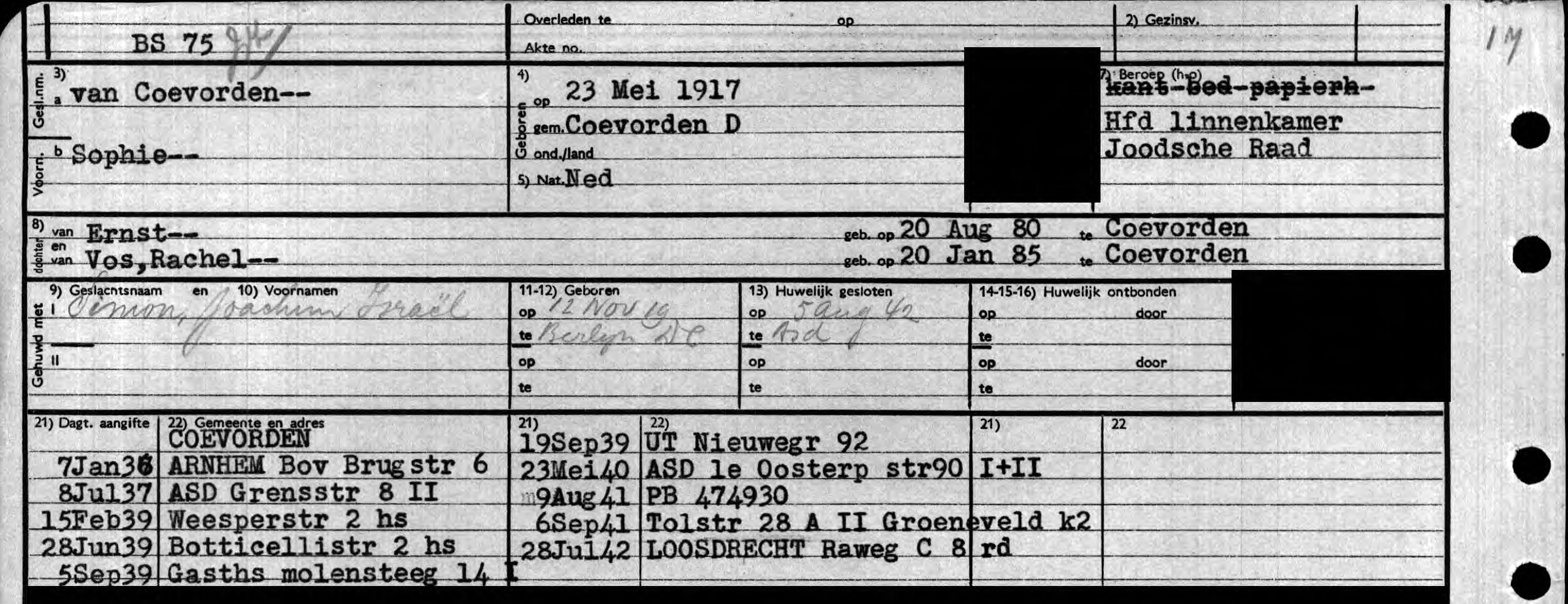
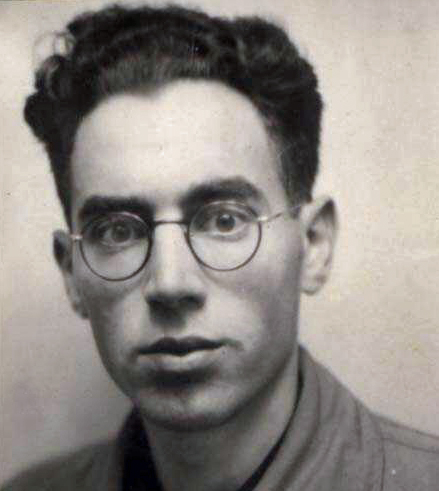
Joachim Simon.
The Food Situation in the Netherlands in 1942.
In 1942, food shortages in the Netherlands increased as a result of the occupation and wartime conditions. A ration card system was introduced, and products such as coffee and sugar disappeared. Food production declined due to the confiscation of raw materials by the Germans and the lack of animal feed. More and more people turned to gathering wild foods, and long lines formed at communal kitchens and shops, highlighting the need for creative solutions such as eating tulip bulbs.
Increasing shortages and distribution
Ration cards and substitute products:
The government introduced a distribution system with ration cards for scarce products, and soon only substitute products were available, replacing real coffee and sugar.
Shortage of raw materials:
The Germans increasingly confiscated raw materials, which reduced the production of fertilizer and animal feed, leading to lower yields in both arable farming and livestock production.
Creative solutions and the black market
Foraging:
The Food Council encouraged people to collect wild vegetables, fruits, and other foods themselves to meet nutritional needs.
Tulip bulbs:
Due to the shortage of potatoes, tulip bulbs were boiled or used in traditional dishes to stave off hunger.
Communal kitchens and the black market:
People depended on communal kitchens, while a thriving black market and widespread food theft emerged.
Restrictions in restaurants and cafés
Meatless days and limitations:
Restaurants and cafés were required to introduce meatless days, and menus always included a meal that did not require ration coupons.
Potatoes in their skins:
On certain days, cooks were required to serve potatoes with their skins, and there were increasing restrictions on the amount of meat and butter that could be served.
In 1942, food shortages in the Netherlands increased as a result of the occupation and wartime conditions. A ration card system was introduced, and products such as coffee and sugar disappeared. Food production declined due to the confiscation of raw materials by the Germans and the lack of animal feed. More and more people turned to gathering wild foods, and long lines formed at communal kitchens and shops, highlighting the need for creative solutions such as eating tulip bulbs.
Increasing shortages and distribution
Ration cards and substitute products:
The government introduced a distribution system with ration cards for scarce products, and soon only substitute products were available, replacing real coffee and sugar.
Shortage of raw materials:
The Germans increasingly confiscated raw materials, which reduced the production of fertilizer and animal feed, leading to lower yields in both arable farming and livestock production.
Creative solutions and the black market
Foraging:
The Food Council encouraged people to collect wild vegetables, fruits, and other foods themselves to meet nutritional needs.
Tulip bulbs:
Due to the shortage of potatoes, tulip bulbs were boiled or used in traditional dishes to stave off hunger.
Communal kitchens and the black market:
People depended on communal kitchens, while a thriving black market and widespread food theft emerged.
Restrictions in restaurants and cafés
Meatless days and limitations:
Restaurants and cafés were required to introduce meatless days, and menus always included a meal that did not require ration coupons.
Potatoes in their skins:
On certain days, cooks were required to serve potatoes with their skins, and there were increasing restrictions on the amount of meat and butter that could be served.